
Evolve Health Mentors spend a full academic year in school with the children staff identify as needing the most support. They set weekly goals with each child and build trust through breakfast clubs, lunchtime activities and after-school sessions.
We track progress through the Evolve Development Tracker (EDT): wellbeing on the 24-question Wellbeing Compass and attendance from school records. In 2025/26 we compared mentees with two groups in the same schools: pupils staff said needed the same help but were not mentored, and all other pupils.
The analysis covers 6,848 pupil records from 25 schools.
Two outcomes, two clocks
Mentees in secondary schools receiving three terms of support finished 1.0pp ahead of their peers on attendance (−1.0pp vs −2.0pp). Those given only two terms finished 5.2pp behind (−6.5pp vs −1.3pp). Controlling for baseline attendance and year group, the difference is 5.8pp (p=0.0003). Note that this is an observational comparison, not a fully controlled trial.
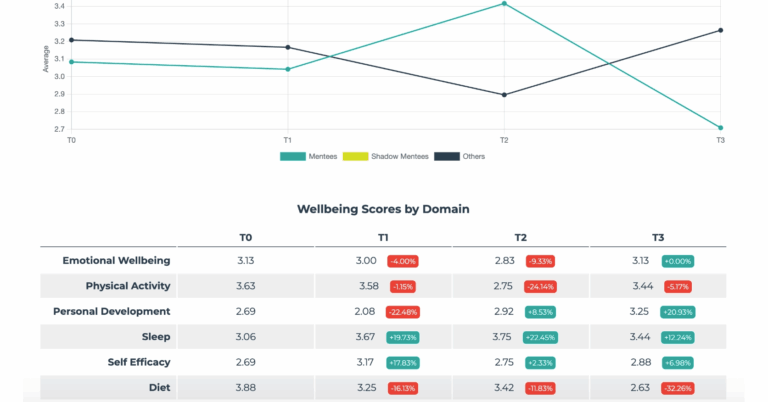
Wellbeing runs on a shorter clock, at least when programmes are in secondary schools. Mentees gained 5.5 points whether their school had two terms or three. This suggests a diminishing return in Term 3, at exactly the time when support is needed to improve attendance.
These findings are different to our work in primary schools where we usually see greatest wellbeing improvements in the third term of each academic year. This may indicate that it takes longer to develop effective mentoring relationships with younger students and programmes should be designed accordingly.
Wellbeing that survives scrutiny
119 mentees with complete before-and-after surveys gained 5.5 points on the Wellbeing Compass. Peers fell 1.3 pts. After adjusting for school, year group, baseline score, gender and free school meals, the gap is still +4.1 points (p=0.0006). Mentees beat peers at every starting level, so this is not regression to the mean. All six wellbeing domains improved.
Movement on the Wellbeing Compass also correlates at r=0.78 with the Stirling Children’s Wellbeing Scale for the same pupils.
Gains where need is greatest
Mentees on SEN Support gained 8.4 points against 0.1 for peers. Mentees eligible for free school meals gained 6.5 while their peers fell by 0.9 pts.
One Health Mentor worked with Wirral Virtual School across five schools for a full year. The 24 looked-after children measured gained 10.7 Wellbeing Compass points, against a 0.6 fall for classmates (effect size 1.22).
What did not go to plan
Mentee attendance fell by 6.5pts in six secondary schools that were part of a wider SAFE Taskforce project, against 1.3pts for peers. Delivery there was only for two terms. That fits the pattern above and raises another important question about when mentoring programmes should be launched. This programme started in January rather than the beginning of the school year in September like all other programmes evaluated in this analysis.
The Evolve Annual Impact Report will be available next month (Nov-26) with more detailed summary and analysis. Email hello@evolvesi.com to receive a copy of this report as soon as it is released.