
A New Grammar for Inclusion
A diagnosis buys time. Time buys support. In England’s SEND system, that currency isn’t distributed evenly.
Professor Susana Castro-Kemp at the University of Birmingham has a name for this. Diagnostic Capital: families with the money, time and know-how to navigate the system secure assessments faster, and everyone else waits behind a label some can buy their way to sooner. Her new paper, published this month in Frontiers in Education, argues that England’s SEND system has become a quasi-market built on exactly that inequality.
A grammar, not a manifesto
The neurodiversity movement gets credit for reframing difference as natural variation rather than deficit. Castro-Kemp’s argument is that it was never built to do the next job: allocate resources, set eligibility or design systems. It is a stance on identity and rights, not an operating model, and she says so without diminishing what it has achieved.
Her proposed fix borrows the World Health Organisation’s biopsychosocial model, the International Classification of Functioning, Disability and Health (ICF), and repurposes it as what she calls a Grammar and a Syntax.
The Grammar is a conceptual shift, from “who qualifies” to “how does this person function in this context.” The Syntax is the ICF’s own taxonomy, which makes that shift operational. Instead of a diagnostic label, a child gets a functioning profile built from four domains: body functions, activities and participation, environmental factors, and personal factors.
Capacity is not performance
The ICF draws a distinction worth sitting with. Capacity is what a child can do in a standard environment. Performance is what they can do in an environment built for them. The gap between the two isn’t inside the child. It’s inside the room.
That single distinction does more work than most SEND policy documents manage in twenty pages.
Four domains, one child
Three of Evolve’s programmes already sit inside that framework, without either being designed with having any prior knowledge of it.
Health Mentoring builds resilience, self-concept and coping, each of which sit within what the ICF calls personal factors, and they respond to relationship, not repetition.
Our ENHANCE neurocognitive development programme trains the body functions domain directly. Attention, working memory, processing speed, the mechanics underneath a difficulty rather than its diagnostic name.
The environmental domain is where the climate of classrooms lives, and it’s the one domain a school can move without waiting for a diagnosis to arrive. The Classroom Climate Survey within our Evolve Development Tracker gives schools a live read on how conducive each learning environment is for all pupils.
A question answered directly
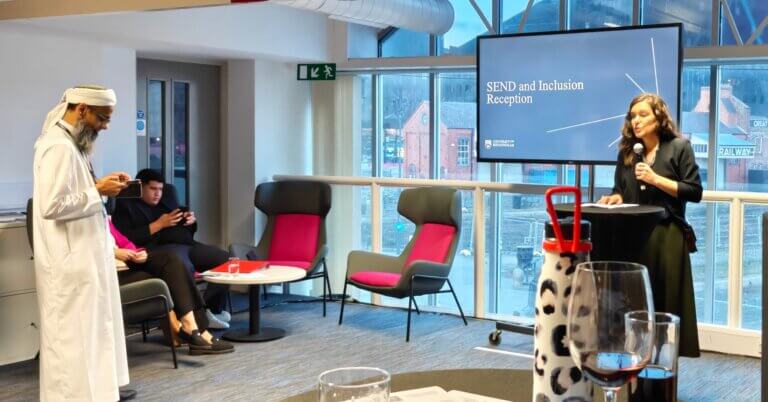
I recently attended a Labour Conference fringe event in Liverpool, jointly hosted by Professor Castro-Kemp and Sir Hamid Patel CBE, on transforming SEND provision.
I asked Professor Castro-Kemp why she did not provide a worked example of personal factors within her paper, since this is the domain that the Evolve workforce is most capable of supporting. The reason for the omission is because the WHO is doing further work on this specific syntax. Developing independent definitions and classifications would lead to fragmentation, which is exactly what the ICF is designed to reduce.
A Wider Lens, Not a New Job
Diagnosis asks what’s wrong with a child. The ICF asks what’s right with a child, and in what context, and what’s getting in the way. That shift, from deficit to function, from a fixed label to a profile that moves with the room a child is in, is the whole case for working this way.
None of this needs a diagnosis, a specialist tool or a referral. Any teacher, in any classroom, can already notice what a pupil can do, what helps them do it, and what gets in the way. This is the real shift that Castro-Kemp is pointing at. Not a new intervention. A wider lens on what good teaching has always tried to do.
Inclusive practice isn’t a bolt-on. It isn’t a base down the corridor, or a programme with its own budget line. It’s high-quality teaching that notices function instead of deficit, and adjusts the room instead of waiting for a label to arrive.
That’s teachable. That’s scalable. And it starts in the next lesson, not the next referral.