

Is Institutional Inertia Stalling SEND Reform?
The Education Endowment Foundation’s (EEF) recent response to the Department for Education’s SEND consultation feels like a masterclass in institutional inertia. As reported in Schools Week, the EEF warned that “significant evidence gaps” on what works for SEND pupils could pose a major challenge to the government’s upcoming inclusion reforms. On the surface, it sounds like a reasonable, scientifically minded caution. Who could argue against wanting more data?
But the latest Department for Education data exposes just how detached from reality this academic caution truly is. We are facing an unprecedented crisis of scale. The number of pupils with an Education, Health and Care Plan (EHCP) in England has just reached a historic record high, surging past the half-million mark to 538,547 children. This represents a massive 11.6% spike in a single year. When you include children on basic SEN support, there are now 1.85 million pupils navigating our education system with additional needs, making up a staggering 21% of the total school population.
It’s worth being clear about what this article is and isn’t arguing. Evidence matters enormously. As an organisation, we’ve invested significantly in research over the past decade precisely because we believe decisions about vulnerable children should be grounded in it. The problem isn’t research itself. It’s the concentration of power over what counts as valid evidence and the growing disconnect between the output of researchers and what schools actually need and use. When centralised research becomes a gatekeeping mechanism rather than a practical resource, it stops serving children and starts serving itself.
Scratch beneath the surface of the EEF’s “lack of evidence” narrative against this backdrop and a far more frustrating reality emerges. With nearly two million children in immediate need of support, we do not have the luxury to sit around waiting for a “perfect” academic consensus. The issue isn’t that evidence-based solutions don’t exist. The issue is that institutions, professional legacies, and a heavy dose of intellectual pride are getting in the way of implementing them.
Where is the Quarter of a Billion Pounds?
Before we accept the claim that “evidence doesn’t exist,” we need to look at the financial context. The EEF was launched in 2011 with a massive £125 million founding grant from the taxpayer. In 2022, they were handed a further £137 million re-endowment.
When an organisation has swallowed more than £260 million in public funding specifically to tell us “what works,” standing up 15 years later to claim there is a “lack of evidence” for our most vulnerable children is disappointing to say the least. This is not a criticism of researchers and schools involved in evaluations, a number of whom I know personally. Rather this seems more of a strategic failure in how resources have been allocated and being out of step with the acute challenges faced by the profession.
Imagine if that quarter of a billion pounds had skipped this centralised research function and gone straight into school budgets. Headteachers and SENDCOs on the ground, driven by immediate necessity, would have figured out what works for their pupils long ago. Instead, the money has fed an insatiable research machine that, understandably, feeds its desire for further funding by asking more questions than it answers.
The Tyranny of the Large-Group Trial
The core of the problem lies in how the EEF defines evidence. They are structurally addicted to large-scale Randomised Controlled Trials (RCTs) designed to look for “statistical power” across massive, generalised cohorts.
This methodology is fundamentally broken when applied to SEND. By definition, special educational needs are highly individualised. What works beautifully for a child with a specific working-memory deficit or a particular profile of autism will completely fail if averaged out across a non-homogeneous group of 5,000 children to check for a “counter-factual.”
When you chase macro-significance, you deliberately mask the micro-successes. The critical nuances of classroom context, teacher implementation, and individual pupil profiles are completely lost in the data wash. Treating children like uniform units in a clinical trial ignores the very nature of neurodivergence.
Hiding in Plain Sight
The truth is, we don’t have an evidence crisis; we have an implementation crisis. Cognitive science has already handed us robust, empirical strategies that directly improve SEND outcomes within mainstream classrooms.
- Managing Working Memory: Utilising explicit worked examples and visual decision-trees to prevent cognitive overload.
- Dual Coding: Presenting information through aligned visual and verbal channels simultaneously, doubling the paths to retention.
- Spaced Retrieval: Replacing the “teach a topic once and move on” model in favour of spaced, low-stakes quizzes to lock down memory pathways for pupils with retention struggles.
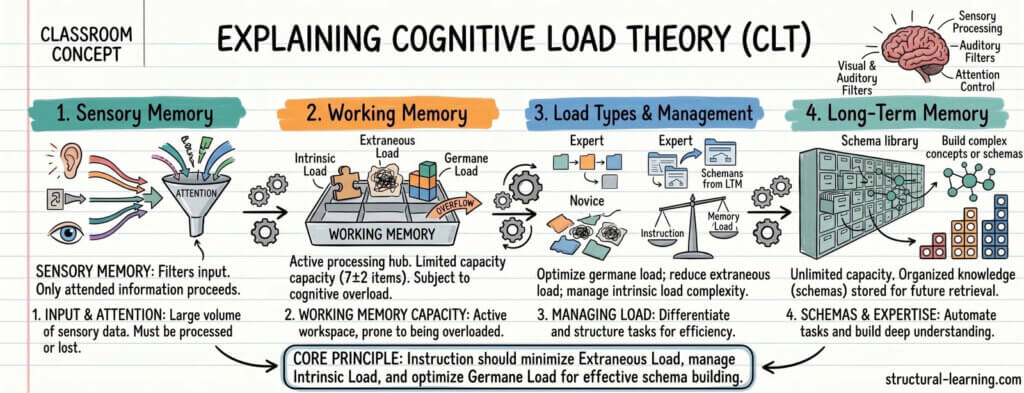
Cognitive Load Theory: The foundation of effective classroom inclusion. Source: Structural Learning / Cognitive Load Theory: 12 Strategies to Reduce Overload
The EEF itself has published reviews endorsing these exact cognitive principles so the “lack of evidence” claim warrants further interrogation before it becomes an off-ramp for change, innovation and progress.
Confronting the 1-1 Outsourcing Myth
This brings us to the absolute core of the DfE’s reform agenda. The White Paper makes it clear that the current SEND ecosystem is built on a broken, unsustainable dependency: outsourcing support to 1-1 Teaching Assistants.
For decades, the legacy approach has been to wait for a child to fail, secure an EHCP, and then deploy a 1-1 Teaching Assistant to act as an individual shield between the student and the curriculum. This isn’t inclusion. This is a form of structural exclusion happening right inside mainstream classrooms. It isolates the child from the teacher who is the true subject expert.
Moving to a model of authentic mainstream inclusion means using cognitive science to design lessons that everyone can access from the outset. When the EEF warns that a focus on adaptive teaching might pose “potential risks at the expense of other pupils,” they are fundamentally misunderstanding cognitive science. High-quality explicit instruction doesn’t harm mainstream pupils. It is the basis of high quality teaching and learning that helps all pupils.
Suffocated by Bureaucracy
The primary barrier to this model is that the current framework forces schools to treat SEND as a legal and administrative battlefield rather than an educational one. The government claims its newly proposed Individual Support Plans (ISPs) will fix this by introducing digital, tiered support to replace the rigid EHCP system. In reality, ISP proposals risk locking schools into even tighter bureaucratic traps.
1. The SENCO: Trading Old Paperwork for a New Onboarding Crisis
The role of the Special Educational Needs Coordinator (SENDCO) is continually championed in government rhetoric as a strategic, senior leadership position and one that is meant to shape whole-school teaching, thereby helping class teachers implement evidence-based strategies. Instead, the legalistic EHCP framework has trapped SENDCOs as full-time administrative case managers.
The DfE promises that standardised, digital ISPs will cut this red tape. Really? School leaders and SENCOs are now facing the staggering, immediate task of auditing and migrating an estimated 1.4 million children currently on basic “SEN Support” onto these new statutory digital documents. Far from liberating the SENCO to model explicit instruction, the next few years will see expert pedagogical resources entirely swallowed by a new, historic administrative onboarding crisis.
2. Shifting the Toxic “Deficit Model” to an Accountability Vacuum
To secure funding in the current system, the EHCP application relies entirely on proving and documenting exactly how much a child is failing. This creates a toxic, counter-intuitive incentive structure:
The DfE wants ISPs to break this “deficit-first” trap by granting fast access to targeted support and “Inclusion Bases” without needing a formal EHCP diagnosis. In reality, ISPs will only succeed if they have equivalent status and the legal teeth of an EHCP.
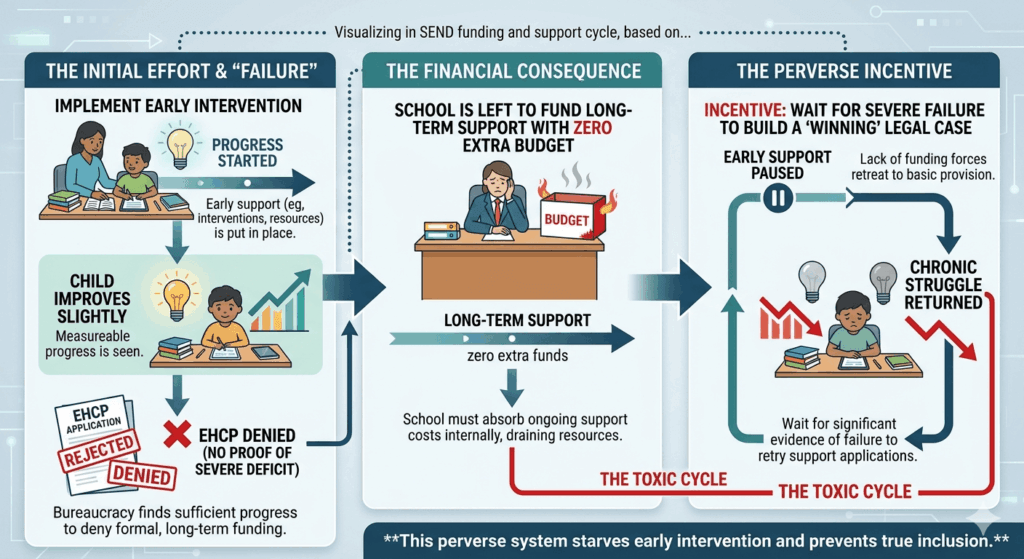
By restricting full EHCPs strictly to severe “Specialist” tiers, the government is aiming to artificially halve the number of plans. If an ISP carries no strict right of tribunal appeal for families, it completely removes local authority accountability. Schools will be left stranded with a massive influx of moderate-needs pupils holding statutory documents that have no financial backing, turning the ISP into nothing more than a digitised spreadsheet documenting a child’s ongoing failure.
The Ghost of BrainGym
Instead of stepping up to lead this change, too many inclusion experts, educators and MAT leaders are falling prey to bad advice from outdated anecdotes claiming that modern, evidence-based cognitive strategies “can’t be trusted”, resurrecting a bizarre, defensive callback to the 2000s pseudo-science of “BrainGym.”
This reveals an embarrassing failure of basic logic and historical amnesia. BrainGym, which is the debunked fad that claimed rubbing “brain buttons” or drinking water on a specific tilt improved lateral processing, was famously held up to public ridicule by the physician Ben Goldacre in his bestselling book and Guardian column, Bad Science. It was precisely Goldacre’s blistering critique of this professional “snake oil” followed by his 2013 DfE-commissioned report, which urged schools to embrace rigorous, medical-style RCTs, that fundamentally shaped government policy. In fact, the EEF was established and scaled up as a direct institutional result of the post-Goldacre drive to cleanse the education sector of fads such as BrainGym.
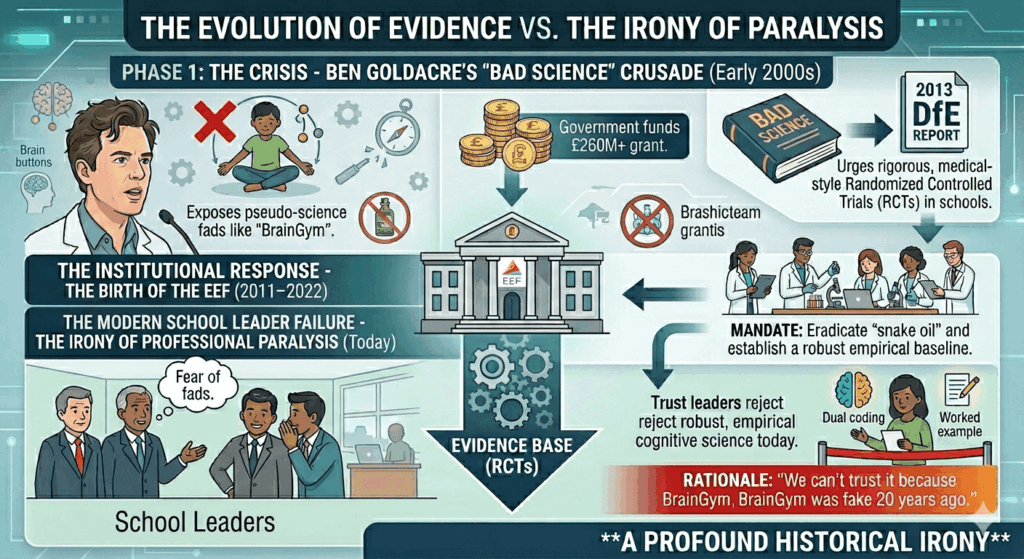
The historical irony is staggering. The EEF was created to replace fads with genuine cognitive and behavioural evidence. Rejecting today’s robust, empirical cognitive science out of fear of a 20-year-old myth that was thoroughly debunked by the very movement that founded modern educational research is absurd.
This is exactly where educational leadership is needed. Rather than outsourcing all of this critical thinking to researchers and external consultants, local authority leaders, MAT CEOs and improvement partners need to trust their own analysis, instincts and experience.
History should sharpen our skepticism against fads while freeing us to implement proven, evidence-based solutions and let the results speak for themselves. However, history seems to have paralysed us, making us fearful of individually implementing professional judgement.
Pride Over Pragmatism
The moment we outsourced the definition of effective teaching to academics and data analysts, we abdicated our frontline responsibility for deciding what works. There is no logical reason why researchers should have the final say and act as the supreme arbiters of educational truth. We must stop letting their institutional pride dictate what counts as “proof,” because this rigid, protectionist culture is exactly why grassroots innovation is being choked out of the sector.
Take our own ENHANCE Programme. It utilises the globally recognised BrainHQ software, backed by an overwhelming avalanche of over 300 peer-reviewed RCTs proving it measurably improves brain health and cognitive function. Under a logical system, this would be a frontline tool for mainstream SEND inclusion. Instead, it faces an unyielding wall of institutional bias, including but not limited to:
- The Geographic Blind Spot: Because most of these 300+ RCTs were conducted internationally rather than within the UK, a handful of unrelated establishment bodies have flatly refused to recognise them.
- The Demographics Myth: The wider clinical literature spans multiple age groups, which is the reason why numerous bureaucrats have dismissed its relevance to education and have willfully ignored the following fundamental biological truth: Neuroplasticity operates on the exact same structural principles whether a brain belongs to an adult or a child.
- The Financial Malaise: The financial cost for a small organisation to fund a localised, large-scale UK trial to satisfy these arbitrary standards is completely prohibitive, creating a system where only large corporates can afford to play, who continue to benefit from stagnation.
Most tellingly, ENHANCE directly challenges the multi-billion-pound, 1-1 outsourcing trap that current specialist provisions are built upon. The establishment would rather protect its legacy structures than embrace a scalable, digital solution that could potentially be cheaper and more effective.
Asking a Different Question
There’s a deeper question here that rarely gets asked. Why do some interventions scale across schools while others don’t?
The honest answer has less to do with the quality of evidence than we’d like to admit. Private equity-backed marketing investments, corporate distribution networks, and relationships with the right people in the right rooms frequently determine whether a product reaches classroom audiences en masse — not just its research base. Having some evidence of effectiveness that passes a school leader’s “sniff-test” has always been a barrier to entry. But it is naive to suggest that the exponential growth of BrainGym (et al) was purely down to “Bad Science”. Maybe we should have invested some of the £260m on exploring these viral coefficients (K-factors) before pinning our hopes on just the one suspect.
The Path Forward
We should apply the same critical scrutiny to “how interventions scale” as we do to “how interventions work”. A system that claims to be evidence-led but is structurally discriminating against newer, smaller and/or less commercial organisations isn’t protecting children from bad science. It’s protecting incumbents from competition.
Therefore, the expert panel developing new national inclusion standards needs to see through this “evidence gap” smoke screen. High-quality teaching, structured small-group interventions, and a holistic understanding of pupil needs aren’t mysterious, undiscovered frontiers. They are known quantities.
Furthermore, if we want SEND reforms to succeed, we have to ensure that key influencers, including this expert panel, are truly representative of the sector. If we want to break the cycle of SEND bureaucracy, we have to change who is leading the conversation. We cannot rely on the architects of our current system to design its escape route.
To expect the very establishment that built this broken apparatus to suddenly innovate our way out of it is just a new recipe for protecting the status quo.