
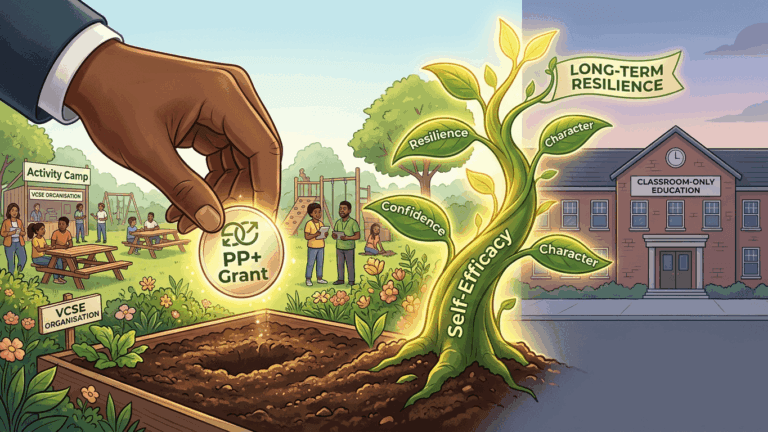
They are the lead equity investor in a portfolio of valuable young lives. Every pound of the Pupil Premium Plus (PP+) grant is capital they deploy to close a widening gap, but the most insightful investors know that the highest returns aren’t found in short-term exam results. While school grades are a necessary metric, they are of little value if a young person’s trajectory still leads to unemployment, housing instability, or the justice system. To truly change a generation, they must invest in the self-efficacy and personal skills that children in care (CIC) often lack because they miss out on the extracurricular “equity” often provided in more stable homes.
The Holiday Investment Opportunities
Traditional education occurs within the 9:00am to 3:30pm window, but the most critical “stress points” for these valuable lives occur in the gaps. Research identifies the “summer slide” (a decline in academic performance during long breaks) and the high-anxiety window of school transitions as major barriers to progress.
There is a powerful argument for VSHs to act as strategic investors by allocating PP+ grants specifically to school holiday periods and after-school activities. These are the times when children in stable families gain valuable self-efficacy through hobbies and community programmes. By partnering with Voluntary, Community, and Social Enterprise (VCSE) organisations that operate outside the normal academic calendar, they can provide a “Longitudinal Lifeline” of support. These community-led programmes can build the social capital and self-esteem necessary to survive the challenges of life, including daunting school transitions and the step into independent living.
Bridging the “Engagement Cliff Edge”
Data shows that at age 11, many vulnerable pupils hit an “engagement cliff edge” where trust in education and a sense of agency drop sharply. This disengagement is a primary risk factor for future school dropout and involvement in serious youth violence.
Investing in enrichment activities, sport, the creative arts and other non-academic pursuits programmes can provide regular “touchpoints” within community settings, allowing these young people to find something they truly enjoy. When a child masters a new skill in a community setting, they build self-efficacy, which is a portable asset. This translates directly back into the classroom, improving attendance, learning behaviours, resilience and academic progress because they now know that they can get better with practice, repetition and belief.
Measuring the Return: The Evolve Development Tracker (EDT)
To be an effective equity investor, you need a way to track your “ROI” beyond the league tables. The Evolve Development Tracker (EDT) provides these insights by measuring the Wellbeing Compass: a child’s sleep, self-efficacy, and emotional regulation.
Our evidence from partnerships like the Wirral Virtual School shows that when we focus on these foundational elements, we see a 5.7% increase in combined wellbeing results. This data proves that the investment is working by developing their resilience and a belief in themselves that will pay dividends when faced with tough choices that could keep them out of the justice system and/or the downward spiral of unemployment.
The Bottom Line
The DfE’s 3-year funding commitment for post-16 PP+ is an invitation to move away from “one-off” projects and start thinking as long-term investors.
The most effective VSHs are those who are thinking long term, laterally and outside the convention of school days and academic terms. Investments in out-of-school experiences that build character, executive function, and hope help to secure positive futures for vulnerable and valuable young lives.